

We ran one support agent on an $8 model and a $0.10 model
- AI agents
- Evaluation
- Cost
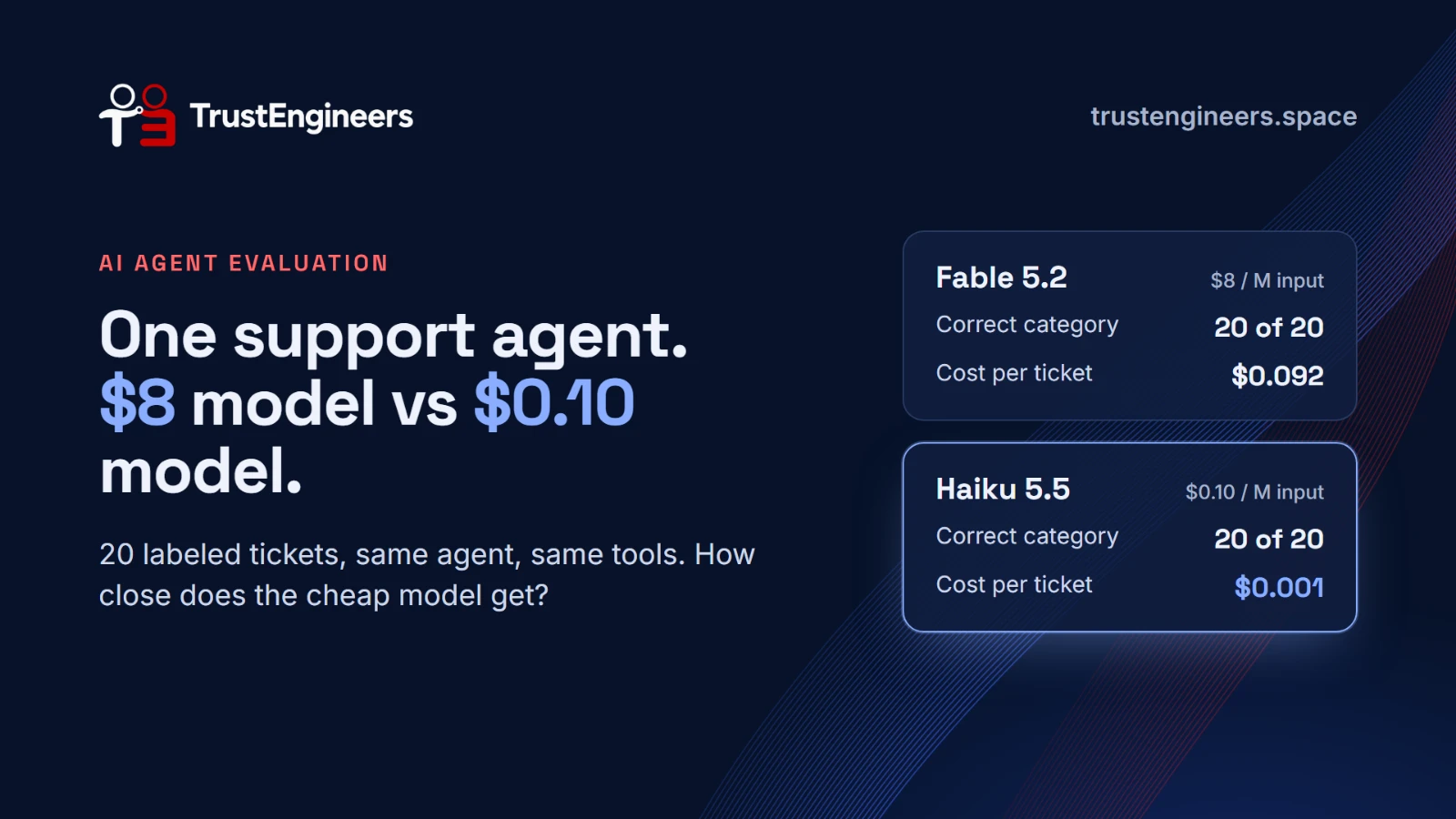
When a new model comes out, the usual question is whether it is better. For most business workloads the more useful question is whether the cheapest model is good enough. We built a small support ticket triage agent to measure that, and published the code and the results.
What we tested
The agent reads an incoming support ticket, classifies it, searches a help center, and then either drafts a reply for a human to approve or escalates the ticket to a person with a reason. The model decides which tools to call and in what order. The loop is written by hand with no agent framework, and it stops after six steps.
We ran the same 20 tickets through two Claude models on November 10, 2026: Fable 5.2, priced at $8 per million input tokens and $40 per million output tokens, and Haiku 5.5, priced at $0.10 and $0.50. The tickets include an angry billing complaint, a vague bug report, an account takeover and one ticket written in Spanish. Each ticket has a label for the correct category and for whether a human needs to step in.
How the agent is built
The agent has four tools: classify_ticket, search_knowledge_base, draft_reply and escalate_to_human. Each turn, the model says in one sentence what it is doing, calls one or more tools, and gets the results back. Our loop only runs what the model asked for. It never decides the next step itself.
The help center is 10 Markdown articles. Search is a BM25 index we wrote from scratch, and it returns the top three articles for each query.
Most of the code is guardrails, because an agent that touches customer tickets has to fail safely:
- Every tool argument is checked: categories must come from a fixed list, text has length limits, and the agent can only reply to or escalate the ticket it is working on.
- Bad arguments, invalid JSON, unknown tools and tool crashes go back to the model as errors it can correct. They never crash the loop.
- If the agent runs out of steps, refuses, or is cut off without a reply or an escalation, the ticket is escalated automatically. No ticket ends without an outcome.
- Replies are drafts for a person to approve. Nothing is sent to a customer.
- Every step is stored in SQLite: what the model said, which tool it called, the arguments and the result. Any decision can be audited afterwards.
The project runs as a FastAPI service and has 39 automated tests covering the loop, the tools, the search and the eval.
Results
| Fable 5.2 | Haiku 5.5 | |
|---|---|---|
| Correct category | 20 of 20 | 20 of 20 |
| Correct escalation decision | 19 of 20 | 17 of 20 |
| Cost per ticket | $0.092 | $0.001 |
| Cost for all 20 tickets | $1.85 | $0.02 |
| Average time per ticket | 12.7s | 5.5s |
| Average tool calls per ticket | 3.7 | 3.4 |
| Tokens used (input / output) | 139,330 / 18,339 | 124,983 / 17,950 |
Both models used a similar number of tokens. The cost gap is almost entirely the price per token: Fable 5.2 cost about 85 times more for the same work. At 1,000 tickets, that is roughly $92 against $1.
Where the cheap model fell short
Haiku 5.5 never put a ticket in the wrong category. All three of its escalation misses went the same way: it sent a ticket to a human that the label said could be answered from the help center. For support, that is the safer direction to be wrong in. It costs some staff time, and no customer receives a wrong answer.
One of those misses was shared with Fable 5.2, and on review the mistake was ours. A customer asked for an invoice with their VAT ID added, and our own help article says only staff can reissue an invoice, so escalating was correct. We left the published numbers as measured.
What this does and does not show
This is 20 tickets that we wrote and labeled ourselves, run once per model. It shows how the two models behave on this set. It is not a general accuracy figure for either model, and your tickets will differ.
What it does show is the method. Before choosing a model for an agent, write down 20 to 50 real cases with the right answer, run every candidate on them, and compare accuracy, cost and speed side by side. It took us an afternoon and about two dollars.
The agent, the tickets, the eval script and the full per-ticket results are public: support-ticket-triage-agent on GitHub. If you want the same comparison run on your own tickets, get in touch.